
WEIGHT-MINDFUL EATING
Nutrient-dense, satiety-promoting — if you respect the portion
Almonds, walnuts and pistachios are calorie-dense AND satiety-promoting. A nutrient-first guide to dry fruits for weight-conscious eating — with honest portion math.
FSSAI Lic. 10020011007944
Crafted since 1939, Delhi
5M+ Indian families served
View curated picks
Weight management depends on overall energy balance, body composition, activity, and individual metabolic factors. Dry fruits are calorie-dense (550–700 kcal per 100g). This page shares dietary facts only — a registered dietitian can build a personalised plan.

Dry fruits sit in an interesting weight-management category: they are calorie-dense (almonds 575 kcal per 100g) AND consistently associated in nutrition research with healthier satiety and even body composition outcomes when consumed in appropriate portions. The mechanism: high protein, high fibre, high healthy fat — a slow-burn nutrient profile that delays hunger return.
Protein and fibre are the most satiety-promoting macronutrients. Almonds carry 21g protein + 12.5g fibre per 100g; pistachios 20g protein + 10.6g fibre. Eating them WHOLE (rather than as butter or in baked goods) tends to deliver the satiety benefit because chewing time itself signals fullness.
USDA: a 30g handful of almonds = ~172 kcal, 6.3g protein, 3.5g fibre. Pistachios similar. Walnuts slightly higher kcal due to fat density. ICMR-NIN: 30g/day is the broad guideline; within a calorie-tracked diet, this fits comfortably. Research consistently flags that whole-nut consumption is NOT associated with weight gain at this serving size when displacing less-nutritious snacks.
Source: USDA FoodData Central, 2024.
Most weight-conscious customers we serve are NOT trying to eat fewer calories — they are trying to eat better calories. The dry fruits we sell since 1939, across 1 million Delhi families, are dense in protein, fibre, and slow-release fats. The trick is portion discipline; we sell 100g and 250g packs specifically so you do not eat a kilo by accident.
Why the brand variable matters
What 85 years of supplying 5M+ Indian families has taught us
Weight-mindful eating depends on the nut being what the label says. Our raw line is unsalted (no fluid retention), unflavoured (no hidden sugar), and unfried (no added oil calories). What you weigh on the kitchen scale is what you actually eat.
Single-origin sourcing
California almonds, Kashmir walnuts, Iranian pistachios — traceable to grower co-ops.
Hand-sorted and quality-checked per batch
Hand-sorted and quality-checked at our ISO 22000:2018 certified facility before our shelves.
Unsulphured by default
Sun-dried or oven-dried. No sulphur-dioxide preservatives in our dried fruits.
Nitrogen-flushed and sealed
Nitrogen-flushed packaging prevents nut-oil rancidity and preserves freshness from seal to table.
WEIGHT-MINDFUL PICKS
Picks for Weight-Mindful Eating
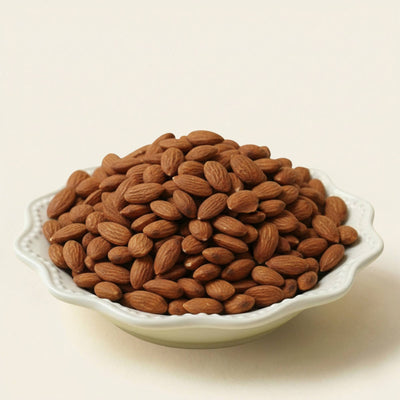
High in protein and fibre, tagged for weight-mindful eating




The nutrient picture
What you are actually choosing for
Each card below names a nutrient relevant to this concern, what it does in the body per established research, and which of our dry fruits carry it. Not therapeutic claims — nutrient facts.
Protein
One of the two macronutrients most consistently linked to satiety, alongside fibre. At typical whole-dry-fruit serving sizes, protein content contributes to the delayed hunger return noted in dietary research.
Found in
Almonds: 21g protein/100g; Pistachios: 20g protein/100g
Adult RDA
Not specified
USDA FoodData Central
Dietary fibre
Fibre
The indigestible portion of plant food that adds bulk to stool, supports gut motility, and feeds beneficial gut bacteria. Soluble fibre absorbs water and softens stool; insoluble fibre adds bulk.
Found in
Anjeer (dried figs): 9.8g fibre/100g; Prunes: 7.1g/100g; Dates: 6.7g/100g; Almonds: 12.5g/100g (mostly insoluble)
Adult RDA
40g/day (ICMR-NIN adult target); average Indian intake is roughly 20-25g/day
ICMR-NIN; USDA FoodData Central
Source: USDA FoodData Central, 2024. Values per 30g serving.
What our customers typically choose
Customers buying with weight management in mind typically pick 100g or 250g packs of raw almonds and pistachios — deliberately smaller bags. The order pattern: weekly small bags rather than monthly kilo packs, treating the smaller packaging as a portion-discipline aid.
Aggregated, anonymous observation from our K-14 Lajpat Nagar shopfloor and order history. Not testimony from named individuals.
How people actually use these
Suggested daily rhythm
Portion guidance, not medical instruction. The three tiles below reflect when our customers managing this concern most often choose to eat — your own clinician will know how to tune this to you.
Morning
With breakfast
5–6 soaked almonds (~30 kcal) as the very first thing in the morning. Combined with water, it serves as both nutrition and mild appetite anchor for breakfast.
Mid-afternoon
The 4pm pause
A weighed 20–25g portion of pistachios as a mid-afternoon snack — instead of a biscuit, namkeen, or chips. The shell pistachios are a built-in pacing mechanism.
Evening
Dessert substitute
A few walnut halves with dinner OR a small handful of almonds (not both) — satiety-promoting nutrients to close the eating window without late-night cravings.
Indicative split based on ICMR-NIN portion guidance for nuts and dried fruits. Individual needs vary by energy expenditure and clinician advice.
These are observational patterns and dietary suggestions, not medical instructions. Consult your treating physician or dietitian for personalised guidance.
Frequently asked questions
What people ask before they buy
Honest, nutrient-first answers. We do not make therapeutic claims; we share dietary facts and serving guidance.
Should I soak almonds before eating them?
Soaking is a long-standing Indian household practice, partly cultural and partly digestive. Soaking softens the skin (which contains tannins that some find harder to digest) and can make the nut feel more palatable. From a nutrient standpoint, USDA values do not change meaningfully with soaking. Eat them whichever way you prefer.
Do you sell unsulphured dried fruits?
Yes — unsulphured is our default. Most apricots and other golden-coloured dried fruits in the wider market are treated with sulphur dioxide (a preservative that keeps the fruit looking bright). Our unsulphured line uses sun-dried fruit; the colour will be darker and more natural. Look for the 'unsulphured' label on the product page.
Where do you source from and what is your quality control process?
We have been sourcing dry fruits since 1939 and currently serve 5M+ Indian families through our K-14 Lajpat Nagar shopfloor. Sourcing is single-origin where possible (Mamra almonds from Iran, Mevawala kishmish from Afghanistan, Anjeer from Turkey). Each batch is quality-checked in our FSSAI-licensed facility for moisture, aflatoxin, and microbial counts, then nitrogen-flushed and sealed within 48 hours of arrival to preserve nutrient density.
Can eating almonds and pistachios help with weight management, given how calorie-dense they are?
Dry fruits carry real calories: almonds run about 575 kcal per 100g. But dietary research consistently associates whole-nut consumption, at ICMR-NIN's 30g/day guideline, with healthier satiety and body composition outcomes rather than weight gain, when the nuts displace less-nutritious snacks rather than add on top of your existing intake. The mechanism is their protein and fibre content, which slows hunger's return. For a plan matched to your own calorie needs, please consult a registered dietitian.
How many calories are actually in a handful of almonds?
A 30g handful of almonds works out to roughly 172 kcal, 6.3g protein, and 3.5g fibre, per USDA data. That is a specific number worth knowing, since 'a handful' can vary widely by hand size and by how loosely or tightly it is measured. Weighing a portion once, on a kitchen scale, gives you a reliable baseline for repeat servings without needing to measure every time.
Why do almonds and pistachios show up so often in weight-management advice?
Protein and fibre are widely considered the most satiety-promoting macronutrients in dietary research. Almonds carry 21g protein and 12.5g fibre per 100g; pistachios carry 20g protein and 10.6g fibre. Eating the whole nut, rather than as nut butter or baked into something, appears to matter too: the chewing time itself is part of what signals fullness to the brain.
Does it matter if I eat almond butter instead of whole almonds?
For weight-conscious eating, dietary research draws a distinction between whole nuts and processed forms like nut butter or baked-in nuts. Whole nuts require more chewing, which is part of what triggers a fullness signal, and they are easier to see and count out before eating. Nut butter in a jar has no natural portion boundary; there is no equivalent to counting or weighing whole nuts before the sitting begins.
Is there a practical trick for not overeating pistachios?
Buying pistachios in-shell is a simple pacing mechanism: the shelling itself slows down how quickly you eat, and the accumulating shells give you a visual cue for how much you have actually had. A weighed 20-25g portion is a reasonable single-sitting serving, closer to a mid-afternoon snack than a bowl to graze from.
Sources
Where the numbers on this page come from
Every nutrient figure and reference daily allowance on this page is drawn from established food-science and government nutrition databases. We do not invent numbers.
- ICMR-NIN. ICMR-National Institute of Nutrition — Dietary Guidelines for Indians and nutrient requirement (RDA) tables View ICMR-NIN
- USDA FoodData Central. USDA FoodData Central — nutrient composition database (vitamin E, ALA, selenium and mineral content per 100g) View USDA FoodData Central