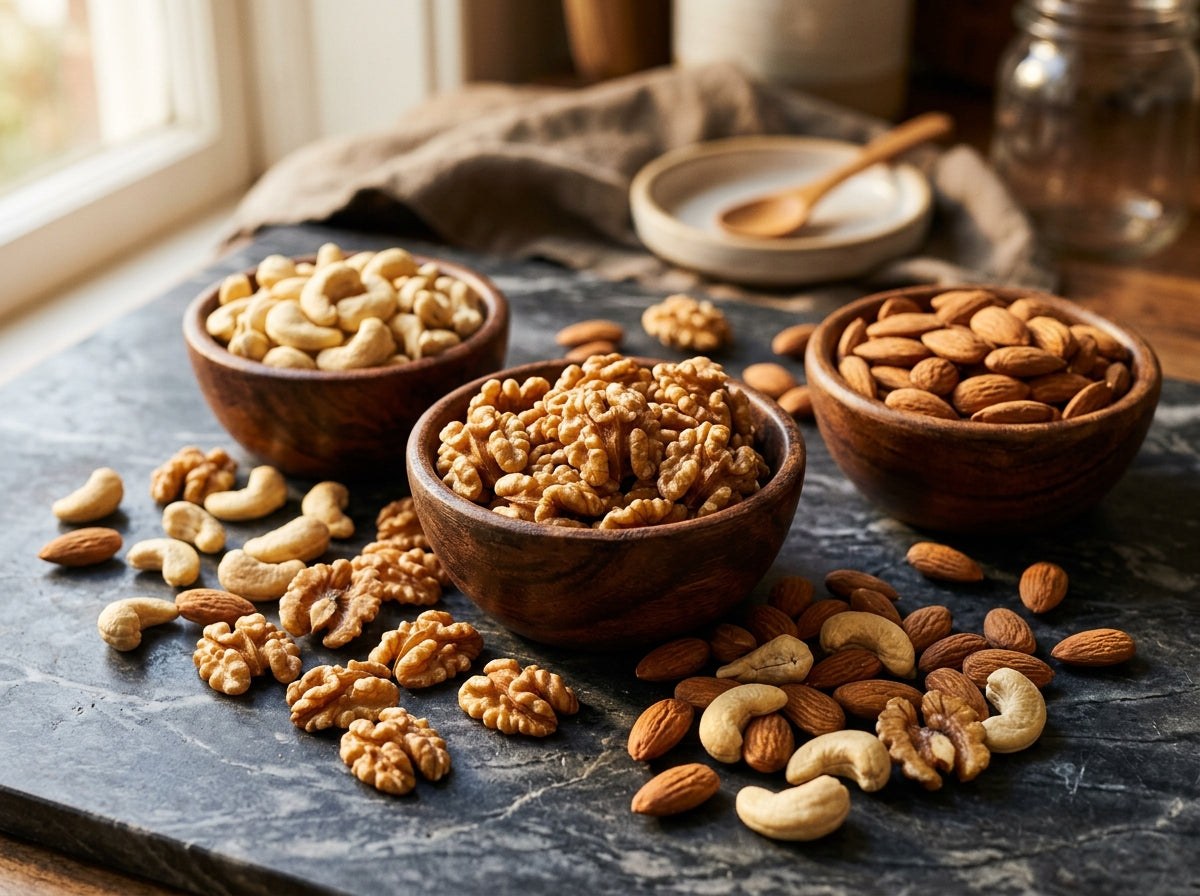
Best Nuts for Brain Health: Walnuts, Almonds, Cashews and More

Nutrition & Wellness

Best Nuts for Brain Health: Walnuts, Almonds, Cashews and More

Walnuts, almonds, cashews, and seeds each offer different nutrients your brain uses daily. Here is what each one does and how much to eat.

4 min read Sindhi Dry Fruits Editorial 23 Aug 2026
~2.5g omega-3 Per handful of walnuts (28g) — plant-based ALA omega-3, the type most studied for brain and heart health in dietary research
~48% DV Vit E Per handful of almonds (28g) — Vitamin E is a fat-soluble antioxidant that may help protect brain cells over time
~20% DV Magnesium Per handful of cashews (28g) — magnesium is involved in nerve signaling and is under-eaten by many adults
4 nut types Walnuts, almonds, cashews, and seeds — each targets a different nutrient gap, not the same thing repackaged

The Findings

What the data actually shows

~2.5g ALA/handful
Walnuts: The Nut Most Researched for Brain Health

A 28g handful of walnut kernels (about 6-7 halves) contains roughly 2.5g of alpha-linolenic acid (ALA) — the plant-based omega-3 fat. Regular walnut consumption has been associated with better cognitive function in multiple observational studies, making walnuts the most frequently cited nut for best nuts for brain health discussions. Our Akhrot Giri (walnut kernels) are ready to eat — no shelling needed, easy to add to your morning oats or pair with a few almonds as a desk snack.

~48% DV Vitamin E
Almonds: The Everyday Vitamin E Source

A 28g handful of almonds covers roughly 48% of your daily Vitamin E requirement (USDA FoodData Central #170567). Vitamin E is a fat-soluble antioxidant; some dietary research associates higher Vitamin E intake with a reduced risk of cognitive decline in older adults, though findings vary across studies and almonds are not a substitute for medical care. On a practical level, a daily handful is one of the simplest ways to consistently include Vitamin E in your diet without supplements.

~20% DV Magnesium
Cashews: Magnesium and the Nerve-Signal Mineral

A 28g handful of cashews (about 18 kernels) provides roughly 20% of an adult's daily magnesium requirement (USDA FoodData Central #170162). Magnesium plays a role in nerve signal transmission and has been associated with sleep quality and stress response in clinical nutrition literature — functions that indirectly support mental clarity. Cashews are mild and filling — equally good in a small afternoon snack bowl or stirred into curd with a teaspoon of seeds.

5 halves + 10 almonds
How Much to Eat and When

A practical daily intake for brain health support is about 4-5 walnut halves (roughly 14g) plus 10-12 almonds (about 14g) — together that is under 200 calories and takes 10 seconds to portion. Morning is the easiest time — leave a small mix in a jar on your desk or kitchen counter so it is already there when you sit down. Roasted cashews work well as an afternoon snack; a measured portion in a small container stops overeating. For any specific health condition, check with a doctor or nutritionist for personalised guidance.

Refrigerate at all times
Storing Brain-Healthy Nuts So the Fats Stay Good

Walnuts, almonds, and cashews all contain unsaturated fats that can turn rancid if stored at room temperature or in heat. All three should be kept refrigerated in airtight containers at all times — especially walnuts, which have a higher polyunsaturated fat content and turn rancid faster than almonds or cashews. Our shelf life for all loose dry fruits is 60 days from purchase; refrigeration is the most reliable way to preserve freshness, flavour, and nutrient quality within that window. For larger quantities, divide into smaller airtight containers.

~1.7g ALA/tbsp
Chia and Flax Seeds: Plant Omega-3 for Non-Nut Days

For anyone who wants to vary their nut intake or manages a tree-nut sensitivity (verified by a doctor), chia seeds and flax seeds are practical plant-based ALA sources. One tablespoon of chia seeds provides approximately 1.7g ALA; ground flax seeds are similarly rich. Neither replaces the full nutrient mix of walnuts or almonds, but as daily additions to smoothies, curd, or oats, they complement a brain-health-focused diet simply. Always check with a doctor about any specific dietary restriction before making major food changes.

Shop This Article

The products behind these numbers

Featured
Sindhi Dry Fruits Akhrot Giri Chilean walnut kernels pack, premium quality

अखरोट गिरी, चिली – ओमेगा-3 से भरपूर

250 ग्राम
₹ 1,275.00₹ 460.00
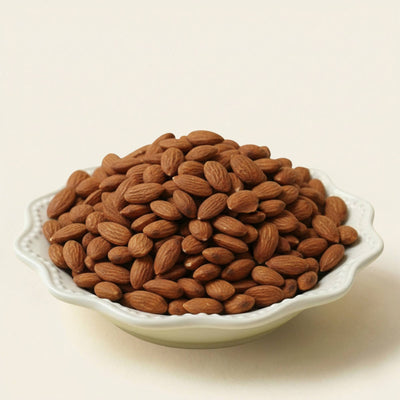
Sindhi Dry Fruits California Almonds (Badam American) pack front, USA-grown almonds rich in Vitamin E

कैलिफ़ोर्निया बादाम, बादाम अमेरिकन, यूएसए - विटामिन ई से भरपूर

250 ग्राम

₹ 360.00₹ 270.00
Kaju Regular whole cashew nuts in a bowl, rich source of plant protein

काजू, काजू नट्स, भारतीय – प्रोटीन से भरपूर

250 ग्राम

₹ 440.00₹ 280.00
chia-seeds

चिया सीड्स – ओमेगा-3 से भरपूर सुपर सीड्स

250 ग्राम

₹ 140.00

Nutrition

What the Numbers Say

✦ AI-Assisted Content
ALA Omega-3 (Walnuts) ~2.5g
Vitamin E α-tocopherol (Almonds) 7.3mg 48% DV
Magnesium (Cashews) ~83mg 20% DV
Protein (Walnuts) 4.3g 9% DV
Copper (Cashews) ~0.6mg 67% DV

Nutritional values are approximate. Source: NIN/ICMR. AI-assisted content — verify with a registered nutritionist before acting on this information.

Frequently Asked Questions

Which nut is best for brain health?

Walnuts are the most researched nut for brain health, largely because of their alpha-linolenic acid (ALA) omega-3 content — about 2.5g per 28g handful. Almonds contribute Vitamin E, and cashews contribute magnesium; both nutrients are involved in brain and nervous system function. Research generally suggests eating a variety of nuts is more beneficial than relying on just one type. A small daily mix of walnuts and almonds, with cashews as an occasional swap, is a practical approach for most adults.

How many walnuts should I eat a day for brain health?

A daily serving of 4-5 walnut halves (roughly 14-15g, or half of a standard 28g serving) is a practical and sustainable amount. Some observational studies on cognitive outcomes used full 28-30g daily servings. Eating more than about 30g provides more fat and calories without proportionally greater benefit for most people. Pairing walnuts with almonds or cashews gives you a broader range of nutrients from a similar calorie intake.

When is the best time to eat nuts for brain health?

There is no clinically established best time for eating nuts for brain health — what matters more is that you eat them consistently. Morning is the most practical time for many people: adding 4-5 walnut halves and 10 almonds to a small bowl before or with breakfast takes seconds. An afternoon snack of cashews is another natural moment. Avoid eating nuts in very large amounts late at night, as the calorie density may disrupt lighter overnight eating patterns.

Should I eat nuts raw or roasted for brain health?

Both raw and lightly roasted nuts retain their healthy fats, protein, and Vitamin E. Heavy roasting at high temperatures can slightly reduce heat-sensitive nutrients like Vitamin E, but the difference for a standard daily serving is not clinically significant. Avoid heavily salted roasted nuts if you are managing sodium intake. Our roasted almonds and cashews are lightly roasted; the ALA content of walnuts is not meaningfully changed by light roasting. Raw or roasted — consistency matters more than the preparation method.

Sources

  1. USDA FoodData Central. Nuts, English walnuts. FDC ID #170187. U.S. Department of Agriculture, Agricultural Research Service. Available at: https://fdc.nal.usda.gov/
  2. USDA FoodData Central. Nuts, almonds. FDC ID #170567. U.S. Department of Agriculture, Agricultural Research Service. Available at: https://fdc.nal.usda.gov/
  3. USDA FoodData Central. Nuts, cashew nuts, raw. FDC ID #170162. U.S. Department of Agriculture, Agricultural Research Service. Available at: https://fdc.nal.usda.gov/
  4. ICMR-NIN 2020. Nutrient Requirements for Indians — Recommended Dietary Allowances and Estimated Average Requirements. Indian Council of Medical Research, National Institute of Nutrition, Hyderabad, India.

Not medical advice — consult a healthcare professional for personal health decisions. Figures reflect one 28g (1 oz) serving per nut type as indicated; values may vary by variety and processing.

Continue Reading

More from Nutrition & Wellness

Where to Find Premium Dry Fruits Near You

Since 1939, Sindhi Dry Fruits has been supplying premium cashews, almonds, walnuts, pistachios and seasonal dry fruits to homes across Delhi, Mumbai, Bangalore and beyond. Order online with fast dispatch to Delhi NCR and pan-India delivery.

Shop Premium Dry Fruits →